
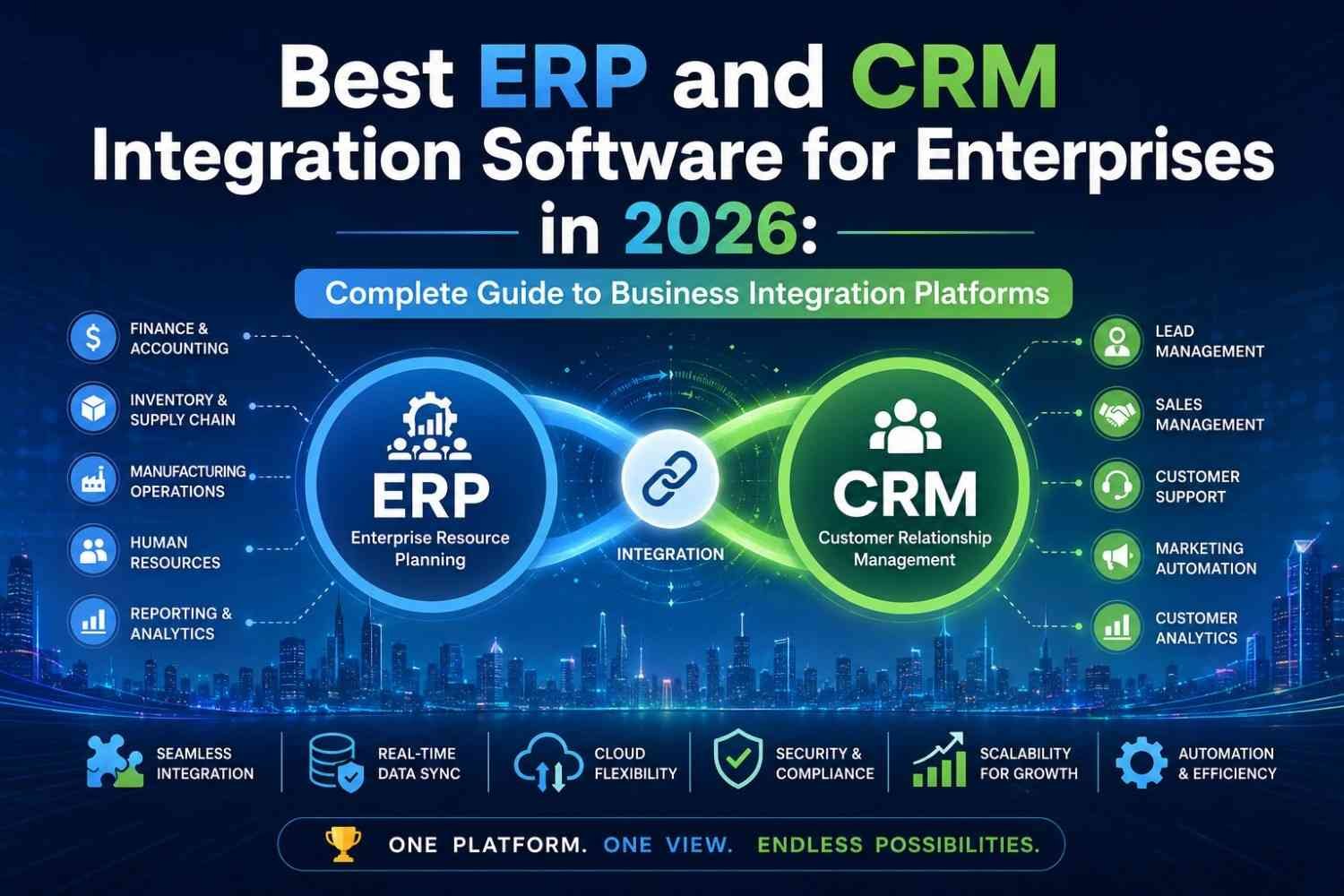
Modern enterprises rely heavily on both ERP (Enterprise Resource Planning) and CRM (Customer Relationship Management) systems to manage business operations. ERP software helps organizations manage finance, procurement, inventory, supply chain, manufacturing, and human resources. CRM software focuses on customer relationships, sales management, marketing automation, lead tracking, and customer service.
However, when ERP and CRM systems operate independently, businesses often face data silos, inefficiencies, duplicate data entry, and reporting challenges.
This is why ERP CRM Integration Software has become one of the most important investments for enterprise organizations in 2026.
Integrated platforms create a unified ecosystem where customer, operational, and financial data flow seamlessly across departments.
What is ERP and CRM Integration?
ERP CRM Integration is the process of connecting enterprise resource planning systems with customer relationship management platforms. The integration enables data sharing between sales teams, finance departments, customer support teams, operations teams, and supply chain managers.
Instead of maintaining separate records, all departments work from a centralized source of truth. This improves accuracy, efficiency, and decision-making.
Why Enterprises Need ERP CRM Integration
Many businesses struggle because customer data and operational data are stored in different systems. Common challenges include duplicate data entry, data inconsistency, delayed reporting, and poor customer experience. Enterprise Integration Software solves these issues by creating automated connections between systems.
Key Benefits of ERP CRM Integration Software
1. Unified Customer Data
Organizations gain access to complete customer profiles, purchase history, payment records, support tickets, and contract information.
2. Improved Sales Efficiency
Sales teams can access real-time information regarding product availability, inventory status, order history, and pricing information.
3. Better Financial Visibility
Finance teams can monitor revenue performance, customer profitability, outstanding invoices, and payment trends.
4. Workflow Automation
Automates lead creation, order processing, invoice generation, customer onboarding, and approval workflows.
Core Features of ERP CRM Integration Software
Real-Time Data Synchronization
Ensures information is automatically updated across systems, eliminating inconsistencies and duplicate records.
API-Based Integration
Modern integration platforms use APIs for scalability, flexibility, and faster deployment.
Data Analytics and Reporting
Provides comprehensive business intelligence for sales performance, customer behavior, revenue trends, and operational metrics.
Cloud ERP CRM Platforms
Cloud ERP CRM solutions offer scalability, remote accessibility, lower IT costs, and continuous innovation.
ERP CRM Integration Trends for 2026
- AI-Driven Integration
- Low-Code Integration Platforms
- Cloud-Native Architectures
- Predictive Analytics
- Real-Time Business Intelligence
Frequently Asked Questions
What is ERP CRM Integration?
ERP CRM Integration connects enterprise resource planning systems with customer relationship management platforms to improve data sharing and business efficiency.
Why is ERP CRM Integration important?
It eliminates data silos, improves automation, enhances reporting, and provides better customer experiences.
Conclusion
ERP CRM Integration Software has become a critical technology investment for enterprise organizations seeking operational efficiency, better customer experiences, and stronger business intelligence.
By connecting ERP systems, CRM platforms, analytics tools, and automation technologies, businesses can eliminate data silos and create a unified digital ecosystem.
As organizations continue investing in digital transformation, Enterprise Integration Software, Cloud ERP CRM Platforms, Business Process Automation, and AI-powered analytics will remain among the highest-value software categories throughout 2026 and beyond.